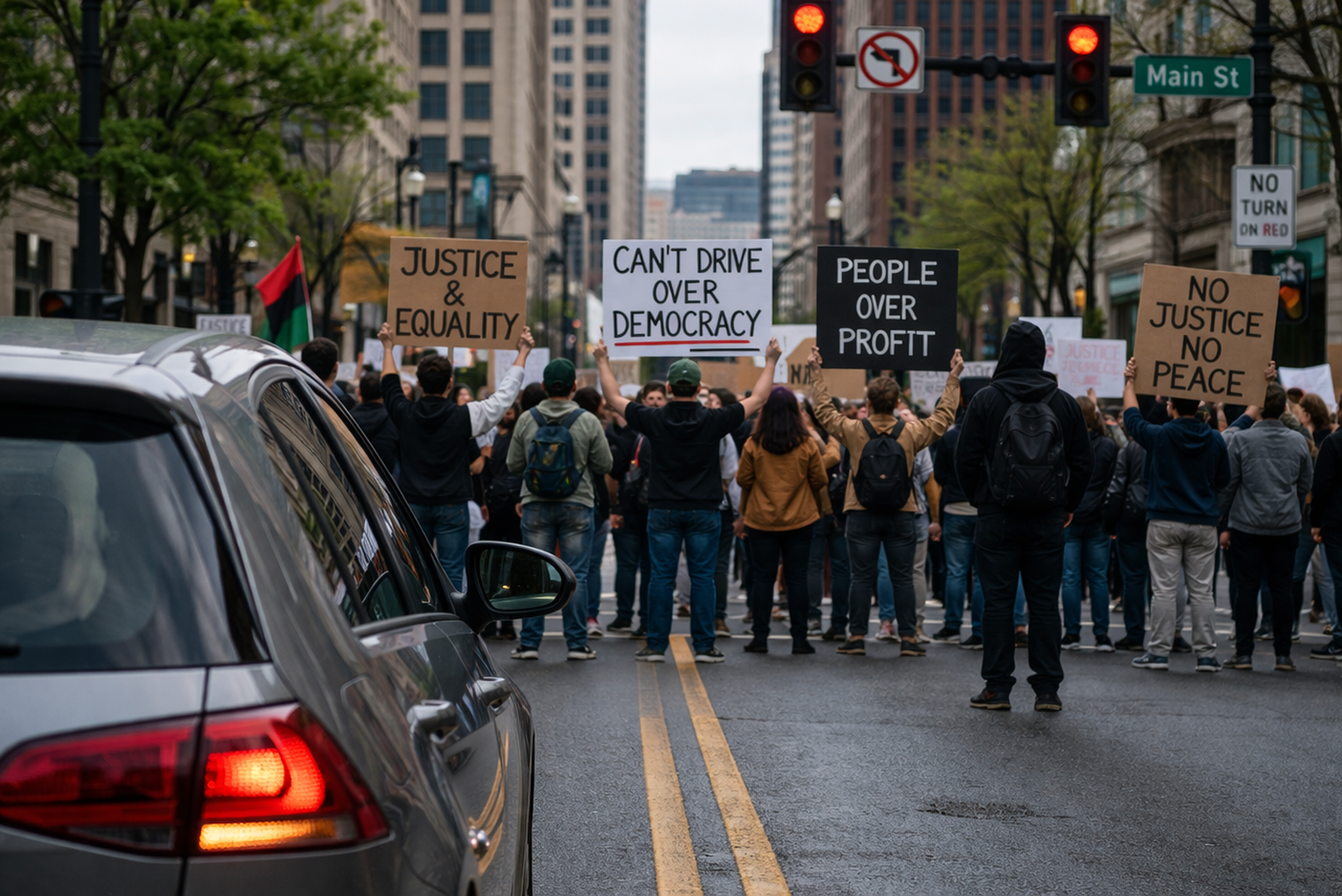
I think this is one of those situations where people need calm, practical advice instead of angry slogans. If protesters are blocking the street, the goal should not be to “win” the moment. The goal should be to get yourself and the people around you out of danger. The safest mindset is simple: do not escalate, do not force your way through a crowd, and do not turn a traffic problem into a life-threatening one. That approach also fits broader public-safety guidance. Ready.gov says that in dangerous public situations, your top priority is to seek safety and get away from the threat when you can, and EMS.gov’s civil-unrest guidance says to exercise caution around large gatherings, stay aware of your surroundings, avoid confrontation, and look for an avenue of escape without panicking.
I also think it helps to remember that protests themselves are not automatically illegal or violent. The First Amendment protects peaceful assembly, but governments can still impose content-neutral “time, place, and manner” restrictions, including rules about permits and traffic impacts. In practice, that means a person can respect the right to protest while still recognizing that blocked streets create a real safety issue for drivers, pedestrians, and emergency access. The Justice Department has said law enforcement has a dual role here: protecting people’s right to peaceably assemble while also maintaining safety and public order when needed.
My first rule: do not drive into the crowd
This is the most important point in the whole article. If people are in the roadway, I would not try to push through them just because I am frustrated or think they should move. Even apart from the obvious moral danger, driving into a crowd can seriously injure or kill people. NHTSA’s pedestrian-safety guidance stresses obeying the rules of the road and protecting pedestrians, and Reuters’ fact check on viral claims from 2020 found there is no blanket legal right to “plow through” protesters simply because they are blocking a road.
To me, this matters because a blocked street feels personal when you are inside the car. You may be late. You may be scared. You may feel trapped. But the vehicle gives the driver enormous force, and that means the driver has an enormous responsibility not to make things worse. Anger is a terrible guide in a crowd situation. Even if the people in the street are wrong to block traffic, the safest move is still to slow down, create space if you can, and look for a way out.
What I would do first if I came upon a blocked street
If I saw a protest ahead while driving, I would slow down early and avoid getting boxed in. If there is a safe, legal chance to turn around before reaching the crowd, that is usually the smartest option. The farther you stay from the center of a tense situation, the more choices you keep. EMS.gov’s civil-unrest guidance says to use caution near large gatherings and seek an avenue of escape while avoiding panic. Ready.gov’s public-spaces advice likewise says getting away from the danger is the top priority.
I would also avoid aggressive driving moves like revving the engine, creeping into people to pressure them, swerving unpredictably, or blasting the horn nonstop. Those actions can easily raise the tension and may cause the crowd to focus on your vehicle. A blocked street is not a normal traffic jam. People are emotional, movement is unpredictable, and one bad decision can change the whole scene. Keeping distance and reducing motion gives you the best chance to leave safely. That is an inference based on the de-escalation themes in public-safety guidance from Ready.gov and EMS.gov.
If you are already stuck in the middle of it
Sometimes a driver does not see the protest in time. Maybe traffic closes in behind you. Maybe the route narrows. Maybe the crowd moves into the roadway suddenly. If that happens, I think the best approach is to stay as calm and nonthreatening as possible. Keep your doors locked, keep your seat belt on, and avoid arguments, hand gestures, or shouting through the window. EMS.gov advises people unexpectedly caught near civil unrest to avoid confrontation, keep a low profile, and seek an avenue of escape without panicking.
I would also keep the vehicle in a controlled state. That means not jumping out of the car unless there is a clear, safer reason to do so. In most cases, your car gives you more protection than standing exposed in a tense crowd. Staying inside also reduces the chance of a misunderstanding or direct confrontation. Again, the guiding principle here is not “stand your ground.” It is “reduce risk.” Ready.gov’s advice for danger in public spaces is to leave when you safely can and call 911 when you are safe.
If the crowd is simply surrounding traffic but not attacking vehicles, patience may be safer than forcing movement. People often want a dramatic answer, but sometimes the right answer is to wait, stay alert, and look for the first safe opening to turn away. That may feel unsatisfying, but a few extra minutes is better than turning a bad situation into a tragedy. This is an inference from the official guidance to avoid confrontation and seek an escape route when possible.
When to call 911
I think 911 is appropriate when the situation becomes an actual emergency, not just an inconvenience. If you are trapped and cannot move, if your vehicle is being attacked, if someone is trying to break in, if people are injured, or if you believe there is an immediate threat of serious harm, call 911 as soon as it is safe to do so. Ready.gov’s public-spaces guidance says to call 9-1-1 once you are safe and describe the situation.
If you call, I would keep the description short and factual: your location, direction of travel, whether traffic is blocked, whether anyone appears injured, whether your vehicle is surrounded, and whether there is an immediate threat. In emergencies, clear facts help more than emotional speeches. If you have passengers, I would have one of them make the call so the driver can stay focused on the surroundings. That last point is common-sense driving safety rather than a quote from one source, but it fits the larger principle of reducing distraction in a dangerous setting.
What not to do
There are a few things I would avoid almost no matter what. I would not try to argue politics from the driver’s seat. I would not film people in a provocative way if it means taking my attention off the road or escalating the interaction. I would not brandish a weapon, make threats, or post up for a confrontation. I would not follow the crowd once I am clear just to record them or “teach them a lesson.” The public-safety logic behind all of this is the same: avoid confrontation, seek safety, and do not turn yourself into part of the conflict.
I would also not rely on internet myths about what drivers can legally do. Viral posts around protest situations often oversimplify or flatly misstate the law. Reuters specifically debunked a widely shared claim that drivers automatically have the right to drive through protesters blocking roads. That is exactly the kind of rumor that can get someone badly hurt or arrested.
Planning ahead matters more than people think
The best time to handle a protest-related traffic disruption is before you are in one. Ready.gov’s general preparedness guidance emphasizes making a plan, staying informed, and using real-time alerts. I think that applies here too. If you know a march, rally, parade, or major demonstration is planned in your city, build extra time into your trip or avoid the area altogether. The FEMA app and local emergency alerts can help people track disruptions and reroute before roads become a problem.
This is one reason I do not think the best answer is purely about the moment of contact. A smart driver tries not to have the contact in the first place. Big demonstrations, whether peaceful or tense, change traffic patterns and can limit access for ordinary drivers. If I had an important appointment, a child in the car, or someone with a medical issue, I would be even more careful about checking route conditions in advance and keeping alternate roads in mind. That is an inference from Ready.gov’s planning guidance combined with the safety concerns around large gatherings.
If you are walking instead of driving
Even though the question is about blocked streets, I think it is worth saying that pedestrians need a similar mindset. If you are on foot and you unexpectedly come near a protest that is becoming chaotic, avoid the densest part of the crowd and move toward a safe exit route. EMS.gov says that if you are suddenly surrounded by a crowd, avoid confrontation, keep your head down, move with the flow, and seek an avenue of escape without running or panicking.
That advice stands out to me because it is so practical. Panic causes falls, bad decisions, and separation from family or friends. Calm movement is often safer than trying to push against everyone around you. Whether you are on foot or in a car, the idea is the same: do not escalate, do not freeze if you have a safe exit, and do not assume the crowd will behave in a predictable way.
Respecting rights while protecting yourself
I think it is possible to hold two ideas at once. The first is that people in the United States have a constitutional right to peaceful protest. The second is that no ordinary driver wants to be trapped in a road blockage, especially if the situation feels unstable. The ACLU says the First Amendment protects protest, but government officials can still impose narrow restrictions, including on marches that block traffic or require street closures. The Justice Department likewise frames public demonstrations as events where authorities must protect both civil liberties and public safety.
To me, that means ordinary people should not treat every blocked street as a personal political battle. A driver’s job is not to settle constitutional questions from behind the wheel. A driver’s job is to stay safe, avoid harming anyone, and get clear of the area. That is the most responsible answer even when emotions are running hot.
What I would tell a friend in one paragraph
If a friend asked me what to do if protesters were blocking the street, I would say this: slow down, do not drive into the crowd, lock your doors, avoid eye-contact battles and arguments, turn around or reroute if you safely can, stay inside the vehicle if getting out would put you at more risk, and call 911 if there is an immediate threat or someone is hurt. That summary is the clearest match to the official themes I found: seek safety, avoid confrontation, and look for an escape route without panicking.
Final thoughts
I think the biggest mistake people make in these situations is letting pride take over. A blocked street feels unfair. It feels tense. It can feel scary and infuriating at the same time. But the safest response is not about proving a point. It is about getting home alive and without harming someone else. Ready.gov’s public-safety advice and EMS.gov’s civil-unrest guidance both point toward the same answer: move away from danger when you can, keep calm, avoid confrontation, and call for help if the situation becomes an emergency.
That is why my answer stays simple. Do not escalate. Do not drive through people. Do not trust viral legal myths. Make space, look for a safe exit, and treat the situation as a safety problem first. In a moment like that, restraint is not weakness. It is judgment.