By me, for people who are curious, cautious, and not trying to become mountain wizards overnight.
Off-grid does not mean “extreme”
When I hear the words off-grid living, I do not picture a movie character chopping wood in a blizzard and never seeing another human again. I picture something much more normal. I picture a person or family trying to control their own power, water, and waste systems instead of depending completely on city utilities. That is the real starting point. Off-grid living is not mainly about drama. It is about systems, planning, and daily habits. In the United States, many homes outside dense towns already depend on private wells and septic systems, and home-scale solar with battery storage is a real option for some households, especially where utility service is hard to reach or outages are common. The Department of Energy explains that solar panels can be paired with batteries so stored energy can be used when the sun is not shining, and EPA and CDC materials show that private well and septic care are normal homeowner responsibilities in many places.
What I like about this idea is that it can be approached in a regular-person way. I do not need to begin by buying land in the middle of nowhere. I do not need to grow every carrot I eat. I can start by learning how much electricity I use, how water gets to a house, what happens to wastewater, and what local rules apply. The most practical off-grid mindset is not “I must do everything myself tomorrow.” It is “I want my home to be more independent, more resilient, and less wasteful over time.” The Department of Energy recommends starting with a home energy assessment, because understanding how a house uses energy comes before making smart upgrades.
The first rule is simple: use less before you make more
This is the least flashy part of off-grid living, but I think it is the most important. Before I dream about solar panels, batteries, and backup generators, I need to shrink my energy appetite. Every light, charger, heater, pump, fan, fridge, and hot-water use adds up. If I waste power, then I need a bigger and more expensive system. NREL guidance says reducing energy use before sizing a solar system is smart, and DOE points out that insulation, air sealing, and weatherization lower heating and cooling costs while making a home more comfortable.
That means I would start with boring but powerful steps. I would seal drafts, add insulation where needed, switch to efficient lighting, pay attention to old appliances, and look hard at anything that creates heat because heating often eats huge amounts of energy. DOE says combining equipment upgrades with insulation, air sealing, and thermostat settings can save about 30% on energy bills. That matters even more for an off-grid home, because every watt I save is a watt I do not have to generate, store, or pay for in equipment.
I think this is one reason off-grid living sometimes disappoints people. The dream is exciting, but the math is strict. A leaky, poorly insulated house can turn a big solar system into a struggling one. A tight, efficient house can make a modest system feel much bigger. So the “normal people” version of off-grid living starts with house basics, not gadgets.
Power usually starts with solar, but batteries matter too
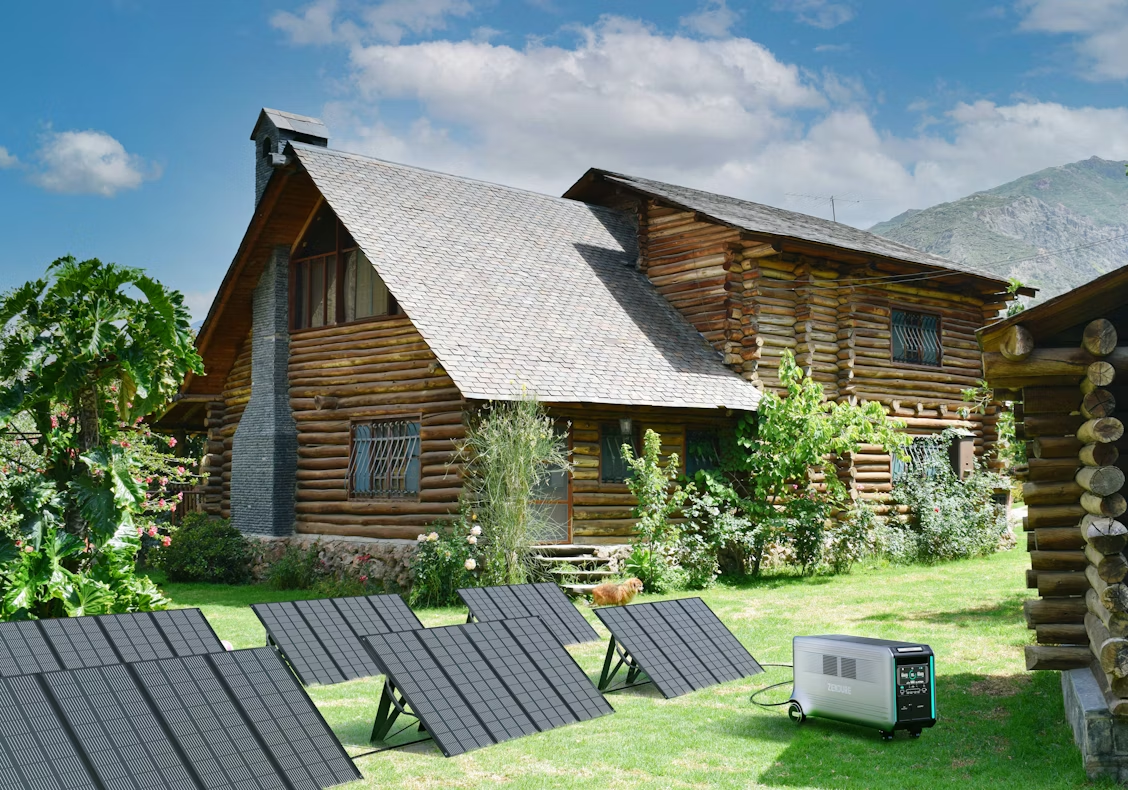
For most people, the most familiar off-grid power source is solar. Photovoltaic, or PV, panels turn sunlight into electricity, and DOE describes solar and storage as a pair that can keep power available after sunset or during outages. That does not mean solar is magic. It means a solar setup has to be matched to real life: cloudy days, winter sunlight, tree shade, dust, snow, and the simple fact that people use energy at night. That is why batteries matter. DOE and NREL both explain that battery energy storage systems collect energy and release it later when needed.
When I think about an off-grid electric system, I break it into parts. First there is generation, usually solar panels. Then there is storage, usually batteries. Then there is control equipment, such as inverters and charge systems, that helps the electricity flow in the right form and at the right time. NREL notes that off-grid systems can be AC-coupled or DC-coupled, which is a more technical design choice, but the big idea is easy: the system has to collect power, store power, and deliver power safely to the home.
I also think normal people should remember that off-grid electric living works best when expectations are realistic. Running LED lights, electronics, a fridge, and efficient pumps is different from trying to power electric resistance heat, huge air conditioners, or every luxury appliance all at once. A family can live well off-grid, but only if the power system and the daily habits match each other. That is why learning your loads matters so much.
Heating and cooling can make or break the plan
If I were helping someone think about off-grid life, I would talk about heat almost immediately. Space heating, water heating, and cooling can be some of the biggest energy users in a house. DOE says heat pumps move heat instead of creating it, which makes them much more efficient than many traditional systems. That can be a big deal in an off-grid or partly off-grid plan, because efficient heating cuts the size and stress of the energy system.
At the same time, heating choices depend on climate. In some places, wood heat might play a role. In others, propane may still be part of the system. In others, a well-insulated home with a heat pump may be the best answer. Off-grid living is not one perfect formula. It is a puzzle shaped by weather, budget, and the kind of home I have. DOE’s weatherization and insulation guidance makes a huge point clear: the cheapest heat is the heat I never lose.
That is why I would never separate “power planning” from “house planning.” A smart off-grid home is often smaller, simpler, tighter, and more efficient than a typical suburban home. That is not a punishment. It is the reason the whole setup can work.
Water is not just about getting it. It is about keeping it safe.
One of the biggest myths I hear is that electricity is the hard part and water is easy. I do not think that is true at all. Water can be one of the trickiest parts of off-grid life because it has to be found, stored, pumped, protected, and tested. For many rural homes, water comes from a private well. CDC says private well water should be tested at least once a year for total coliform bacteria, nitrates, total dissolved solids, and pH, and local health departments may recommend more testing depending on the area. EPA also notes that drinking water rules for public systems exist, but private well owners are responsible for monitoring their own systems.
That tells me something important. Off-grid living is not just about freedom. It is also about responsibility. If I have a private well, I cannot assume the water is safe just because it looks clean. Testing matters. Maintenance matters. The pump matters too, because many wells depend on electricity to move water into the home. That means water planning and power planning are connected. No electricity can also mean no running water unless the system is designed with that risk in mind.
Some people also collect rainwater. EPA materials say there are no federal regulations governing rainwater harvesting for non-potable use, but state and local rules vary widely. That means I should never assume rainwater is automatically legal for every use in every place, especially for drinking.
For me, the normal-person lesson is this: do not romanticize water. Treat it like the serious system it is.
Waste has to go somewhere, and that “somewhere” needs rules
If a home is off-grid, it may also be off sewer. That usually means an onsite wastewater system, often a septic system. EPA says septic maintenance is built around four basic ideas: inspect and pump frequently, use water efficiently, properly dispose of waste, and maintain the drainfield. That is a good reminder that septic systems are not magic underground boxes that solve everything forever. They are systems that can fail, smell bad, contaminate land and water, and become very expensive if ignored.
I think this is where off-grid dreams meet reality in a healthy way. The dream says, “I want independence.” The reality says, “Great, then learn how wastewater works.” People who already live with septic systems are not unusual. They are homeowners with a different kind of infrastructure. But septic systems must match the soil, the lot, the water table, and local public health rules.
USDA guidance for rural housing materials notes that wells and septic systems need required separation distances, and one USDA document says a domestic well must be at least 50 feet from the septic drain field, or more if local or state codes require it. Other USDA materials say local or state standards may control. That tells me not to memorize one number and assume it applies everywhere. Local code wins.
This is one of the strongest lessons in off-grid living: being independent does not mean being unregulated. In fact, many off-grid choices become more important to regulators because they affect health and groundwater.
Backup plans are not optional
A lot of beginners think “off-grid” means a perfectly self-running home. I think a smarter picture is “a home with layers.” Solar might be layer one. Batteries might be layer two. A generator might be layer three. Stored water might be layer four. Shelf-stable food might be layer five. The point is not to trust one system with everything.
Generators are a good example. CDC warns that portable generators produce carbon monoxide, an odorless gas that can kill without warning. They should never be used inside a home or garage, and CDC says they should be used outside, more than 20 feet from windows, doors, and vents. Homes using generators should also have battery-powered or battery-backup CO detectors.
To me, that means backup power is useful, but only if safety comes first. Off-grid life is full of tools that are helpful when used correctly and dangerous when used lazily. Wood stoves, propane, batteries, generators, fuel storage, ladders, chainsaws, wells, and septic systems all reward careful habits.
Food, daily routines, and the myth of doing everything yourself
When people imagine off-grid life, they often jump right to gardens, chickens, and homegrown meals. I love that picture, but I think it can also pressure people into trying to become experts at everything at once. I would not treat food production as the first test of whether someone is “really” off-grid. I would treat it as one layer of resilience.
A garden can help. Learning to store food can help. Cooking at home can help. But normal people still go to grocery stores, still buy flour and rice, still need refrigeration, and still live in seasons where gardens do not solve every problem. The healthiest version of off-grid living is not a purity contest. It is a practical system where some of my needs are produced at home and the rest are handled in thoughtful ways.
That is why I like the phrase self-reliance better than total isolation. A self-reliant home is a home that can handle more on its own. It does not have to prove anything by rejecting every convenience.
The law, permits, and boring paperwork can save you from disaster
This may be the least exciting section, but I think it might save the most heartbreak. Before I spent serious money on land or equipment, I would check zoning, building permits, septic approvals, well rules, electrical inspections, and rainwater rules. I would also ask whether a property can legally support the systems I want. USDA and EPA materials both point to the importance of proper distances, testing, and health-related rules for private water and wastewater systems.
The reason this matters is simple. A place can look perfect on a map and still be difficult or expensive to build on legally. Maybe the soil will not pass for a septic system. Maybe the local code has strict requirements. Maybe the land is flood-prone. Maybe the well will be expensive. Maybe the utility company is nearby enough that grid-tied with backup batteries is actually smarter than full off-grid.
That last idea matters a lot to me. “Off-grid” is not always the best answer. Sometimes the best answer is grid-optional: a super-efficient home with solar, battery backup, and strong emergency planning. That can offer much of the resilience people want with fewer headaches.
So, is off-grid living realistic for normal people?
Yes, but only if “normal” means patient, teachable, and willing to plan. No, if “normal” means hoping vibes will replace math, maintenance, and permits.
The biggest lesson I come away with is that off-grid living is less about escaping society and more about understanding systems. I need to know where my power comes from, where my water comes from, where my waste goes, how heat is managed, and what backup plan protects me when something fails. The Department of Energy, EPA, CDC, USDA, and NREL all point toward the same truth from different angles: a successful home system is built on efficiency, maintenance, safety, and good design.
So if I were giving one piece of advice to someone curious about this life, it would be this: start smaller than your fantasy and smarter than your fear. Track your energy use. Learn your local rules. Get a home energy audit. Understand water. Respect septic. Build backups. Do not try to become an expert in ten things in one weekend.
That version of off-grid living feels real to me. It feels possible. And best of all, it feels like something normal people can actually do.